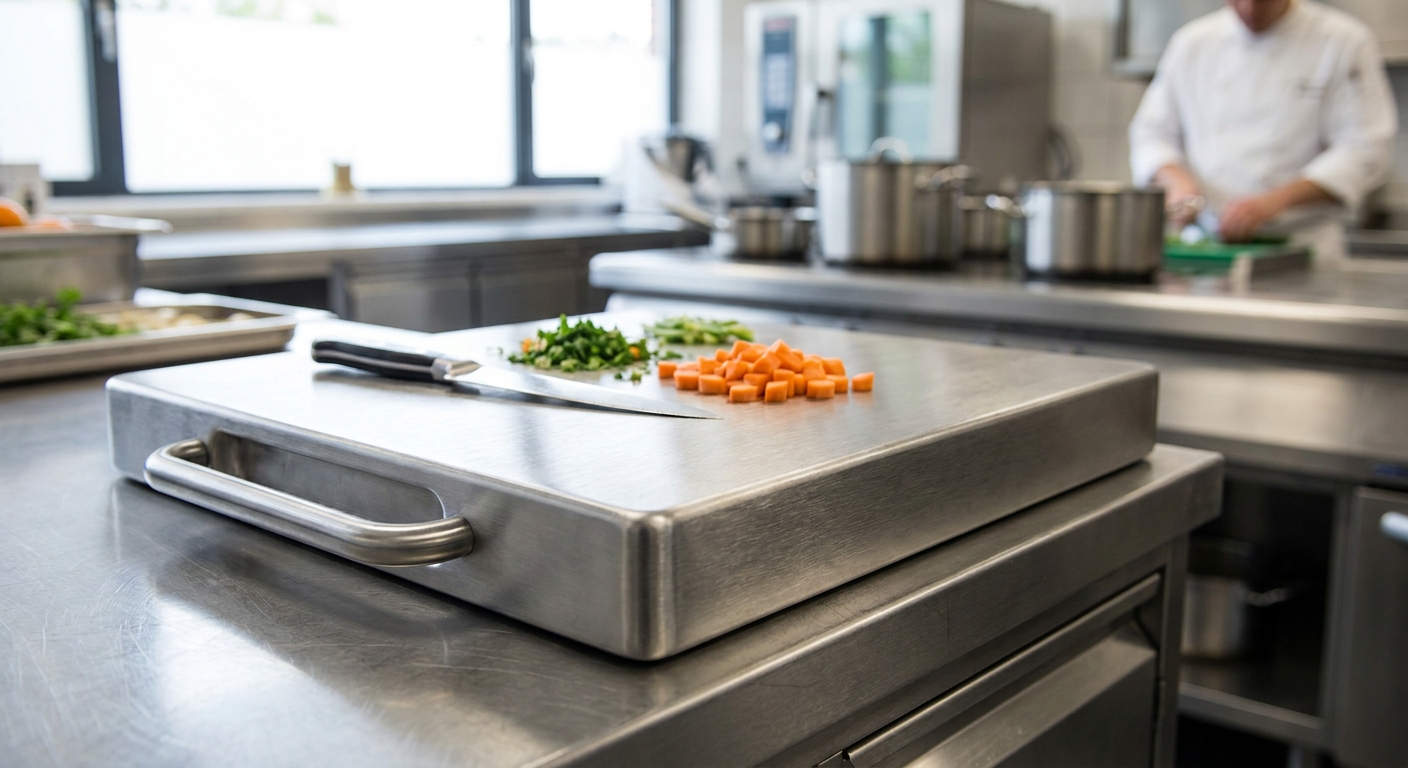
Stainless steel chopping boards show up in commercial kitchens because they wipe clean under bleach-strength sanitiser and pass a HACCP inspection without argument. This guide ranks where a stainless steel chopping board earns its spot on a 2026 prep line, and where a hardwood board still does the cutting job better and kinder to your knives.
- Black Castle & Hare's Double-Sided Stainless Steel Chopping Board at EUR24.99 wins for cold prep and presentation stations - Buy.
- Stainless steel dulls knife edges faster than wood or HDPE, so keep it off the main butchery station.
- HDPE colour-coded boards remain the HACCP default for raw meat, fish, and veg separation in 2026.
- End grain hardwood butcher blocks close over knife marks and outlast steel on daily butchery work - Buy.
- Fixed stainless worktops used as cutting surfaces are a Skip - they slip, ring loud, and chew through blade edges.
Why this matters
Commercial kitchens live and die by food safety audits, not brand preference. Saw Swag builds hardwood boards for home cooks in Kildare, but the hygiene logic that pushes professional kitchens toward a stainless steel chopping board applies just as much to a home kitchen prepping for a crowd.
Search demand for stainless steel chopping board sits at 260 monthly searches in Ireland with a keyword difficulty score of 0 in 2026 data - there's room to answer this properly instead of recycling a spec sheet. The honest verdict: stainless steel earns a place on cold prep and presentation stations, not on the board where the knife does the real work, night after night.
How we ranked
Every board on this list gets judged against what a commercial kitchen actually checks during an audit in 2026: how it holds up to daily bleach-strength sanitising, whether it dulls a knife edge within weeks, how it fits Ireland's HACCP colour-coding expectations, and what it costs to replace once volume triples during a busy season. A board that fails hygiene checks or chews through blade edges inside a month gets marked Skip, whatever it costs upfront. This isn't a spec-sheet exercise - it's what survives a line doing 200 covers a night.
The ranked list
1. Black Castle & Hare Double-Sided Stainless Steel Chopping Board - the cold-prep specialist
At EUR24.99, this is the stainless steel chopping board most commercial kitchens actually reach for, and it earns the spot for one reason: it's built double-sided so one side handles cold sandwich work while the other stays clean for plating. Stainless steel resists staining and odour absorption better than any wood or plastic, which matters at a garnish station running back-to-back covers.
It is not the board for raw meat portioning or heavy knife work - the surface is hard enough to blunt an edge inside a shift. Use it for cold prep, dessert plating, and presentation. Verdict: Buy for cold stations, skip for butchery.
2. HDPE colour-coded boards - the HACCP default
High-density polyethylene boards remain the standard raw-meat, fish, and vegetable separation tool across Irish commercial kitchens in 2026, and for good reason: they're lightweight, dishwasher-rated, and the colour system (red for raw meat, blue for raw fish, green for veg) is understood by every inspector who walks through the door.
They score more easily than steel and need replacing sooner, but that's the tradeoff for a surface that's cheap enough to swap out on a schedule rather than nurse along. Verdict: Buy as your primary raw-prep surface.
3. End grain hardwood butcher block - the butchery workhorse
End grain wood takes knife impact differently to steel or plastic: the fibres close back over a cut rather than staying scored open, which is why butchery counters have used it for generations. It also holds an edge better than any hard surface, meaning less time at the steel between cuts. A detailed breakdown of what to look for sits in the guide to chopping boards for professional butchers.
It weighs more than a stainless steel chopping board and needs regular oiling to stay sanitary, but on a butchery station that's a maintenance cost worth paying. Verdict: Buy for portioning and butchery work.
4. Edge and face grain hardwood boards - the chef's line pick
Lighter than end grain but still far kinder to a blade than steel, edge grain boards suit a chef's line where speed matters more than raw impact resistance. The wood grain runs parallel to the cutting surface, which keeps the board flatter under heat and moisture swings than a thinner stainless steel chopping board left near a stove. The construction differences that matter for a professional kitchen are covered in the guide to end grain butcher blocks for professional chefs.
It's not the surface for raw meat separation under HACCP rules, and it needs the same oiling discipline as any hardwood. Verdict: Buy for chef-line prep, pair with colour-coded boards for raw meat.
5. Fixed stainless worktop used as a cutting surface - the one to skip
Some kitchens skip a dedicated board altogether and cut straight on the stainless steel worktable. It looks clean until the knife marks turn it into a maze of scratches that trap bacteria and refuse to sanitise properly. It's also loud, slippery under wet hands, and murders a blade edge faster than any board on this list.
“A stainless worktop looks clean until the knife marks turn it into a trap for bacteria.”
There's no scenario in a 2026 commercial kitchen where cutting directly on a fixed steel surface beats a dedicated board. Verdict: Skip.
Comparison table
| Option | Material | Best for | Knife wear | Verdict |
|---|---|---|---|---|
| Black Castle & Hare Double-Sided Board | Stainless steel | Cold prep, plating | High | Buy |
| Colour-coded boards | HDPE | Raw meat/fish/veg separation | Moderate | Buy |
| End grain butcher block | Hardwood | Butchery, portioning | Low | Buy |
| Edge/face grain board | Hardwood | Chef's line prep | Low-moderate | Buy |
| Fixed steel worktop | Stainless steel | Nothing - use a board | Very high | Skip |


Where to buy
- Buy a stainless steel chopping board for the stations that need wipe-and-go speed - cold prep, dessert plating, garnish - not for the station running raw meat through a knife all shift.
- Keep raw protein on a dedicated colour-coded or hardwood surface, never on the same stainless steel chopping board used for cold plating. The full separation logic is laid out in the guide to picking the right chopping board for raw meat and fish.
- Replace any board, steel or wood, the moment it scores deep enough to trap residue - a scratched stainless steel chopping board is no more sanitary than a scored plastic one.
FAQ
What's the best stainless steel chopping board for a commercial kitchen in 2026?
The Black Castle & Hare Double-Sided Stainless Steel Chopping Board at EUR24.99 is the strongest option for cold prep and plating stations in 2026. It isn't built for raw meat butchery or heavy knife work - keep that on wood or colour-coded HDPE.
Is stainless steel or wood better for a commercial chopping board?
Wood wins for actual cutting work because it dulls knives less and the fibres close back over marks instead of staying scored open. Stainless steel wins for wipe-clean speed on cold stations where knife contact is light.
Does stainless steel dull knives faster than wood?
Yes, stainless steel is harder than any wood board and blunts an edge noticeably faster with repeated contact. Butchers and chefs who cut all day still reach for end grain hardwood for this reason.
How much does a commercial-grade stainless steel chopping board cost?
A double-sided stainless steel chopping board runs around EUR24.99 in 2026, well below a hardwood butcher block, which typically sits between EUR75 and EUR170 depending on size and wood species.
Can you use a stainless steel board for raw meat prep?
You can, but Irish commercial kitchens generally keep raw meat on colour-coded HDPE boards to satisfy HACCP separation checks. Steel is non-porous but scratches from knife use can still trap residue if not sanitised properly after every use.
Do commercial kitchens still need HACCP colour-coded boards if they use stainless steel?
Yes. Colour-coded boards remain the standard for separating raw meat, fish, and vegetables regardless of whether a kitchen also uses a stainless steel chopping board for cold stations.
How do you sanitise a stainless steel chopping board properly?
Wash with hot soapy water after every use, then sanitise with a food-safe solution and let it air dry fully before storing. Check the surface regularly for deep scratches, since a scored stainless steel chopping board holds bacteria just like a scored plastic one.
Is a stainless steel chopping board dishwasher safe?
Most stainless steel chopping boards are dishwasher safe, which is one of the main reasons commercial kitchens use them for fast-turnaround cold stations. Confirm with the specific product listing before running it through a high-heat commercial dishwasher cycle.
One last thing
The surprising part of sourcing for 2026 isn't the stainless steel chopping board itself - it's how few commercial kitchens actually use one for anything beyond cold prep. Ask a working butcher or chef which board takes the daily knife punishment and the answer is almost always end grain hardwood, not steel. Stainless earns its keep on wipe-and-go stations; wood earns its keep everywhere a blade actually meets the surface.