Chopping boards go grey, crack, and split when they dry out between washes — a food-safe mineral oil and a wood conditioner every few weeks stops that, and this guide gives you the exact routine for 2026.
- Food-safe mineral oil, not vegetable oil, is the correct oil for chopping board maintenance in 2026.
- New boards need 3 coats before first use; established boards need oiling every 2-4 weeks.
- Board butter (oil plus beeswax) seals the surface between mineral oil applications.
- A grey, dull board is thirsty, not dirty — oil fixes it, soap does not.
- Skip walnut or vegetable oils entirely; they go rancid on end-grain wood within weeks.
Why this matters
Wood shrinks and swells with every wash cycle. A board with no oil barrier absorbs water straight into the grain, then dries too fast and cracks along the seams — that's the hairline split you see running down the middle of a neglected board.
Oiling isn't cosmetic. It fills the wood's pores so water can't get in, which is the difference between a chopping board that lasts 10 years and one that splits by year two. Saw Swag builds boards from solid hardwood specifically because dense grain holds oil well and resists warping — but even the best hardwood board needs the routine below to earn that lifespan.
What you'll need
- Food-safe mineral oil — the only oil for chopping board use that won't turn rancid (avoid olive, vegetable, or walnut oil)
- A wood conditioner or board butter (oil blended with beeswax) for the finishing layer
- A lint-free cloth or paper towel
- Warm water and mild dish soap for cleaning beforehand
- 20-30 minutes and a flat surface where the board can sit undisturbed for a full day
If you're prepping a brand-new board — including anything freshly delivered from a Co. Kildare workshop in 2026 — treat it before its first real cut. Raw wood straight off the bench has zero protective barrier.
The steps
1. Wash and dry the board completely
Run the board under warm water with a small amount of dish soap, scrub any food residue off, and rinse. Stand it upright or lay it flat on a towel and let it air dry for at least an hour. Oiling over trapped moisture seals damp wood in, which is exactly what causes warping and mould pockets later.
Common mistake: oiling a board that's still damp to the touch. Wait until it feels bone dry, not just surface-dry.
2. Pour a generous pool of mineral oil onto the surface
Use roughly a tablespoon per side for a standard board, more for anything over 40cm. Don't dab — pour a puddle and spread it with the cloth so every inch of the surface, including the edges and end grain, gets coated. End grain drinks oil faster than face grain, so it needs extra attention.
3. Work the oil in with the grain
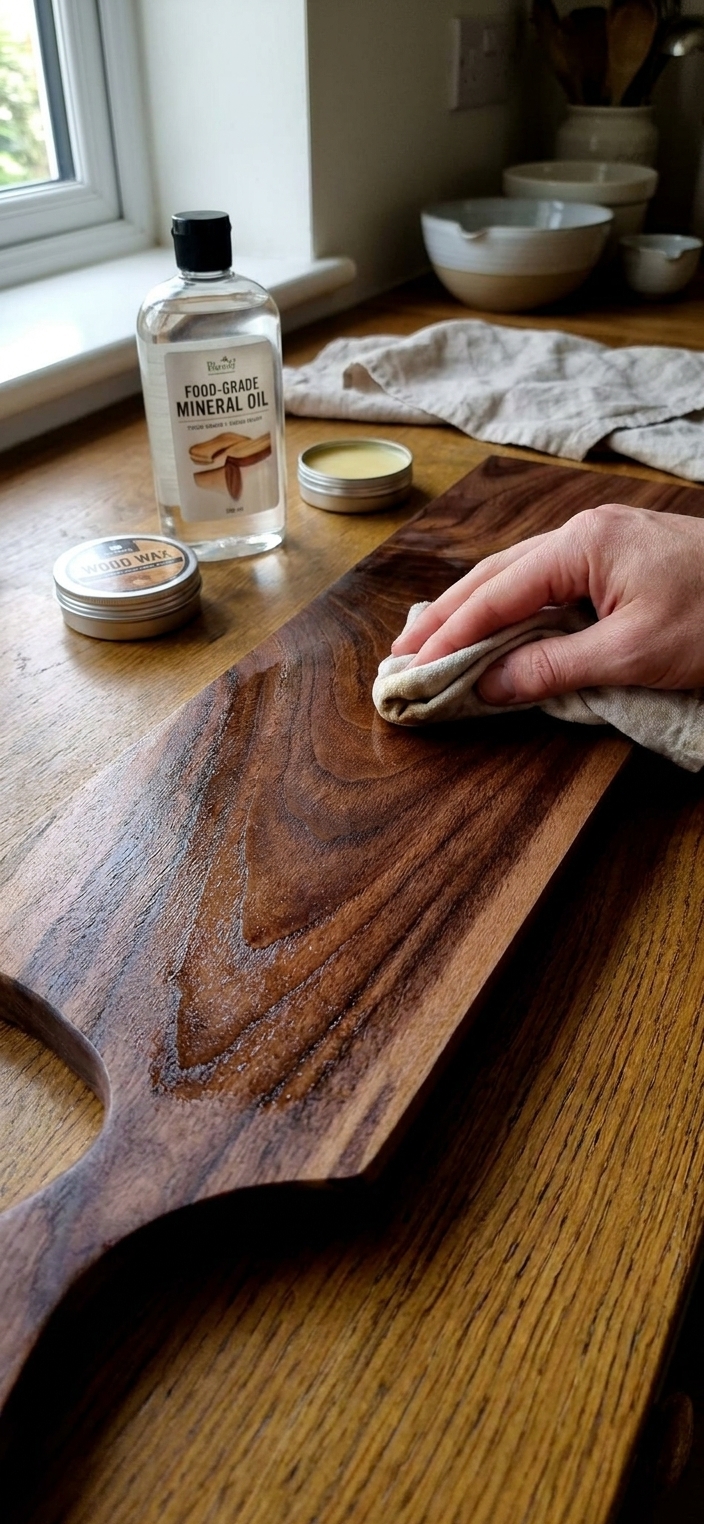
Using a folded cloth, rub the oil in circular motions first, then finish with straight strokes following the wood grain. This pushes oil into the pores rather than leaving it sitting on top as a film. Spend at least 2 minutes per side on a board this size.
4. Let it soak for 20-30 minutes, then wipe excess
The wood will visibly darken as it absorbs oil — that's the pores filling. After 20-30 minutes, wipe off anything still sitting on the surface with a clean cloth. Leftover oil on top goes tacky and attracts dust; it does nothing extra for protection once the wood is saturated.
5. Repeat 2-3 coats for a new board
A brand-new board hasn't built up any oil reserve, so one coat won't be enough. Apply a second coat once the first has absorbed (usually 4-6 hours later), and a third the next day if the wood still looks dry or pale in patches. Established boards that already have a season of oiling behind them need only a single coat per session.
6. Cure for 24-48 hours before heavy use
Let a freshly oiled board sit somewhere at room temperature, away from direct heat, for a full day before it goes back into daily rotation. Cutting hot food or running it through a dishwasher-adjacent sink before the oil cures strips the work you just did.
Common mistake: oiling on a Sunday night and using the board Monday morning for wet ingredients. Give it the full cure window.
7. Follow up with board butter every few weeks
Once the mineral oil layer has settled, a wood conditioner or board butter — oil blended with beeswax — adds a top seal that resists water beading better than oil alone. Apply it the same way, buff in, and let it sit 15 minutes before wiping.


“If your board looks pale and dull after washing, it needs oil, not more soap.”
Troubleshooting
- Board still looks grey after oiling. One coat wasn't enough — apply a second coat and let it cure a full 24 hours before judging the result.
- Oil beads up and won't absorb. The surface is already saturated; wipe off the excess and skip oiling for another 2-3 weeks.
- Cracks appearing along the grain. The board went too long between oilings and dried out fully. Oil it immediately, then hold to a strict 2-4 week schedule for 2026 and beyond.
- Sour or rancid smell developing. Someone used vegetable or olive oil instead of a food-safe mineral oil — those oils oxidise and turn. Sand the surface lightly and re-oil with mineral oil only.
- White or black spots forming. That's early mould from moisture trapped under a film of unabsorbed oil. Sand lightly, let the board fully dry for 48 hours, then re-oil with thinner, more frequent coats.
- Board feels sticky after conditioning. Too much board butter was applied at once. Buff harder with a dry cloth and reduce the amount next time.
Tools and resources
- Food-safe mineral oil, applied every 2-4 weeks
- Board butter or wood conditioner, applied every 4-6 weeks as a top seal
- A dedicated cloth kept only for oiling, never for cleaning
- A well-built board to begin with — a Saw Swag hardwood board holds oil better than soft or laminated boards because the grain is denser
What to do next
Once oiling is part of your routine, the next failure point is usually storage — boards left flat against a wet counter or stacked while damp warp regardless of how well they're oiled. Stand boards on edge between uses and keep them away from direct heat sources like dishwashers or radiators.
FAQ
What is the best oil for chopping board maintenance in 2026?
Food-safe mineral oil is the best oil for chopping board care in 2026 because it doesn't oxidise or turn rancid like cooking oils do. Board butter, a mineral oil and beeswax blend, works as a secondary sealing layer on top.
Can I use olive oil on a wooden chopping board?
No — olive oil and other cooking oils go rancid inside wood grain within a few weeks, leaving a sour smell. Stick to food-safe mineral oil or a dedicated wood conditioner.
How often should I oil a wooden chopping board?
Oil an established board every 2-4 weeks, and a brand-new board with 2-3 coats before its first real use. Boards used daily for wet or acidic food need oiling closer to the 2-week mark.
How long does chopping board oil take to dry?
Mineral oil absorbs into the surface within 20-30 minutes, but the wood needs 24-48 hours to fully cure before heavy use. Wipe off any oil still sitting on top after the absorption window.
Is board butter the same as mineral oil?
No. Mineral oil penetrates the wood grain, while board butter blends oil with beeswax to form a surface seal on top. Use mineral oil as the base treatment and board butter as a follow-up every 4-6 weeks.
Why is my chopping board cracking?
Cracking almost always means the board dried out between oilings and the wood shrank unevenly. Re-oil immediately and hold to a 2-4 week schedule going forward to stop it recurring.
Can I oil a chopping board that already has knife scratches?
Yes — oiling doesn't fix scratches but it does stop them from harbouring moisture and bacteria. Light sanding before oiling smooths deeper cuts if they bother you.
Does the type of wood change how often I need to oil it?
Denser hardwoods like walnut and beech hold oil longer than softer woods, so they can stretch toward the 4-week end of the interval. Softer or end-grain boards drink oil faster and need attention closer to every 2 weeks.
One last thing
The biggest mistake isn't skipping oil entirely — it's using the wrong oil once and assuming the board is protected for months. A single coat of mineral oil buys roughly 2-4 weeks of protection at most; treat the oiling schedule as a recurring habit for 2026, not a one-time fix, and a solid hardwood board will easily outlast a laminated one that gets ignored.